My visits to Cousin Pete Zarko in Gaic were coupled with visits to the Lopin side of the family in Dubrovnik and in our ancestral village of Zuljana. My Lopin grandparents were third cousins. My grandmother’s maiden name was also Lopin. They even grew up in the same selo. A Croatian village can be made of several selo, groups of houses build on rock, fertile fields separating each selo from the other. Good soil is rare in much of the country, so you don’t waste it by building. The selo my grandparents grew up in is called Pozerina, and consisted of a dozen or so two and three story houses structured around a common cistern. Water is the other precious commodity.
My first trip, in 1972, began in Dubrovnik. My cousin Zejlko was expecting me, but as was typical of my communication skills at the time, only “sometime during the summer”. I had his address, but when I arrived tired and hungry after traveling by train from Istanbul, I couldn’t gather the intelligence to find him, so with the help of the tourist office I booked a room in a private house. The host noticed my last name.
“You’re Croatian, yes?”
“My family.”
“And does your family live in Dubrovnik?”
“A few, and the others in a village not far from here.”
“There are lots of villages.”
“It’s called Zuljana.”
“Are some of your family called Lopin?”
“Yes! My mother’s cousins!”
“Zejlko is a my good friend. He has been expecting you all summer. Why are you staying here?”
Within thirty minutes, Zejlko had come to claim me and I was installed in the guest room of an apartment that was essentially a part of the city wall.
Dubrovnik was like another world to me. A perfect walled city almost surrounded by water so blue it looked fake. Libertas was (and is) Dubrovnik’s summer arts festival, and despite my temporal nonchalance (or maybe because of it) I was there for the most active part. I saw world-famous pianists, performances of folkloric dances, ballet, Macbeth on the ramparts (in Croatian), orchestras, jazz, and more. At the end of the week, Cousin Maria and her son Niko, took the ferry to Zuljana, and I tagged along.
Niko was about ten at the time. He was overweight, and he sputtered, yelled, whined, and was – like me – an only child. I tried very hard to like him. I don’t remember succeeding. Maria was a worrier, fussy, emotional, and a chatterbox. She was also a fabulous cook, so I liked her better. Her husband Miho was a man of infinite patience and calm. I thought him a saint.
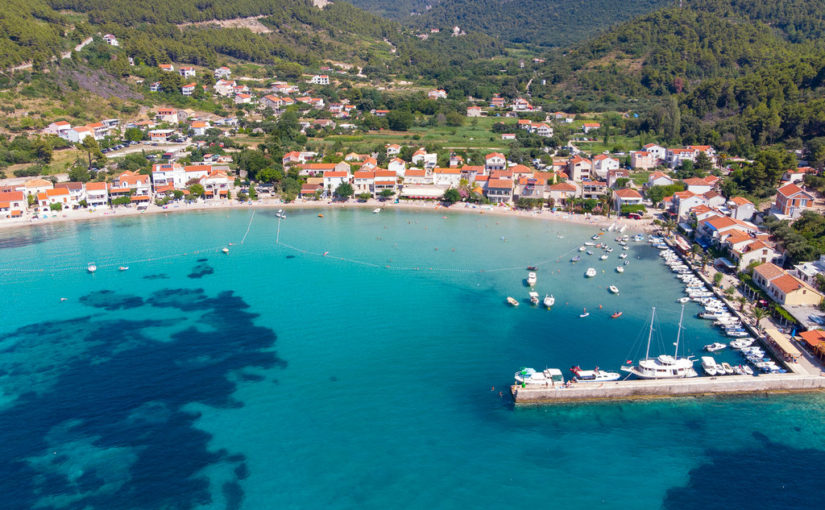
Zuljana is on the coast, and has a little artificial harbor that was provided by the Austrians. The ferry slipped through the inlet, a group of people waved excitedly, and I was welcomed back to the homeland.
Memories of my two trips to Dubrovnik and Zuljana tend to conflate, as do memories of my trips to Gaic and Ravno. It was on the first trip that I hiked up to Pozerina with cousins Pero and Navenka to look at the houses my grandparents grew up in, by then abandoned and in ruin. On the second floor of my grandfather’s house I found a box, almost the only thing in the room, and inside the box were postcards and letters. Two of those letters were from my grandfather, but only the envelopes had survived. My grandmother’s house no longer had a second floor. The cistern was overgrown with blackberries, and mosquitoes were rampant.
Still, in my American way, I imagined a full restoration of the selo and conversion into a heritage hotel. Being me I shared the dream with everyone, and never did a thing about it. Well, my language skills that trip were pretty slight, so describing my developer’s vision was unlikely to convince, anyhow.
I had taken Russian in high school, all four years, in the hope that it would help me learn Croatian. Grandma Zarko died a year into that experiment so we never got to try it out, and though my folks both spoke Croatian fluently, it was awkward trying to speak at home. In Zuljana, I began to pick it up, but it was all about the dictionary, and conversations – if you could call them that – were painful for everyone.
Still, when a group of Czech tourists befriended my cousins, they could often not understand one another even though the two languages were close. But somehow I could understand both so I became their imperfect, and totally thrilled, translator. Then one night on the pier while we passed around a bottle of homemade sweet vermouth I cracked my first joke in a foreign language. Someone made note of the full moon, and riding on the lunar landing of a few summers prior, I declared that moonlight was now subject to an American tax. Okay, not exactly Mel Brooks, but they laughed.
Pero and his dad, Marko, were busy that summer coaxing a cistern from the granite outcrop their house was built on. They would spend an hour drilling a hole by hand, place the explosive, pack it, stretch the fuse, light it, take cover, and… boof!. Not “boom”, boof. The charge would blow a toaster-sized section of rock into a loose amalgam which Pero and Marko cleared out with pickaxes. Those two weeks saw the cistern grow to about the size of a steamer trunk. No one was perturbed by this timeline. It was the way it was.
And all that while, Veronika, Pero’s mother, carried five liter jugs of water down from a well high enough on the mountain that the water wasn’t brackish from infiltration of the sea. It was still slightly too mineral for good dental health, however, and was used mainly for cooking and washing. Water and rock shaped their lives.
When I returned three years later, the ferry had stopped running and Zejlko took me by car. We arrived late. The whole family was in Veronika’s kitchen to greet me. I had not spoken a word of Croatian in three years (Zejlko spoke English) and was groggy from travel. People asked lots of questions. I answered them. About a half hour into the conversation, someone remarked how much my Croatian had improved, and they were right.
“It was a struggle for us before, we’re glad you’ve been studying.”
More amazed than they were, I left it at that.
The big excitement was about water. Veronika went to the sink, and turned on the new faucet full blast.
“Look! We have as much as we want, now!”
“You finished the cistern!”
“No,” said Pero, “we might turn it into a wine cellar, though.”
“Where is the water coming from?”
“Canalization!” cheered Marko.
The government had given Zuljana a grant to train a villager in hydraulic engineering, then everyone in town either signed on to provide labor, or paid a kind of tax if they opted not to. Together they built a ten thousand liter reservoir high on a hill, dug a fifteen meter well down to reliably fresh water, and laid pipe to every house in the village.
“Main lines, service lines, all professional!” enthused Marko.
As close as I now live to them, and as many times as I’ve vacationed in Italy before I moved here, I’ve never been back. I regret that.