My first Fourth of July was at the Lucas’s house. They lived directly across the street from Washington Park which was launch central for the Sunnyvale fireworks display. Sitting in their front yard, comfortably bunkered in lawn chairs or lounging on picnic blankets, my adult relations waited to admire the colors that would soon explode directly overhead. I was three, and had no idea what to expect. When the first sky rocket whistled into position and burst noisily above us, I wasted no time running — screaming — into the living room where I sought out furniture high enough off the floor for me to hide under.
The bangs kept coming, muted only slightly by the walls and windows of my grandparents-on-loan’s tract house, and with every new terror I lodged myself further under the table that protected me. But the capacity for humans to adapt is remarkable, even for three-year-old humans, and as the oohs and aahs made me curious as to what I was missing, I crawled out of hiding to watch the show through the front window, and eventually on a blanket. I don’t recall if parental intervention helped get me there or not. It was an intensely personal progression – abject terror to aesthetic appreciation – and even if adults seemed to help me through it, I was basically on my own.
My later attraction to theatre caused me to face the same transition from terror to pleasure on purpose, and regularly, in both rehearsal and performance, for decades thereafter.
I don’t know if the location of our pyrotechnic parties changed because the civic display was moved from Washington Park as the city grew, which eventually was the case, or if it was a family event, like Grandpa Lucas’s passing, that changed the venue, but memories of the Fourth after those several years across from the park, are mostly set on the Lopin ranch in Cupertino.
My mother and her four younger siblings grew up on ten acres of fruit orchard their father planted around 1904 and in a house he put up in 1920. In the dining room hung formal portraits of my Lopin grandparents, my grandmother with a strange white mound on the top of her head that was identified by Aunt Mary as a chrysanthemum, but only after years of my wondering what it was. My grandfather’s portrait showed a man with a face and upper body completely out of kilter; shoulders, ears, and eyes dislevel with each other in ways almost random, and nose out of alignment in the other direction. But all in all they were a handsome couple.
Grandpa Lopin died when I was six and my cousin Gail, his only other grandchild, was about ten, and I recall very little about him. The house was of a peculiar design that required passing through bedrooms to get to other bedrooms, and in which it never quite felt that any room, except kitchen and bath, was being used for its intended purpose. My grandfather lay dying in a small bedroom immediately off the kitchen – on the way to the bath, master bedroom, and other rooms of puzzling utility – and I remember visiting him there. Gail did, too. She later told me that the day before he died, she came to see him and he kept pointing to the corner of the room.
“What are you pointing at, Grandpa?”
“He’s waiting there for me. What joy.” He wasn’t, by any report of his children, a religious man.
My mother said I could attend his funeral, but I chickened out. Later she mentioned that Gail had asked after me, if I was okay. If I was going to come pay my respects. I felt a bit ashamed for staying home.
“Gail cried.”
“She did? Why?”
“Because she missed Grandpa.”
“Oh.” I was too embarrassed to admit that I had thought she’d cried because I hadn’t come to the funeral. Always the center of the universe. Or maybe it was just a question of syntax.
The yard behind the house was shaded by a huge pepper tree and two large figs. The area beneath them was paved with green concrete, where Uncle John built a rudimentary fire pit for grilling chicken and steak, and spicy sausage of his own production. The slab also served as a good staging ground for roadside stand pyrotechnics.
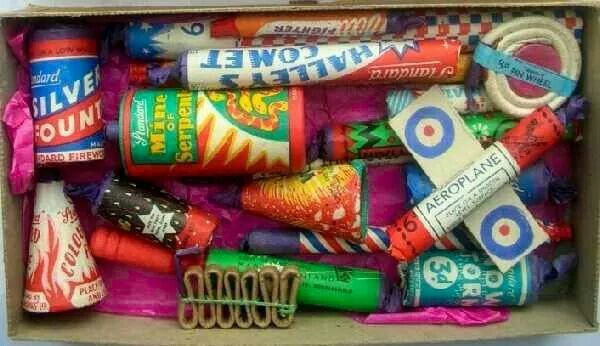
They were simple confections – a little color, bright light, and sometimes a gentle whistle – but when Aunt Mary oo’ed, and Uncle John chuckled, and Dad said “that was a good one! Let’s see what this one’s like…” the Roman candles and sparklers seemed in their simple, homey sincerity more than a fitting celebration of a nation’s bedrock principles. Don’t be fooled, though, simple and homey didn’t come cheap. The deluxe box I wanted to buy cost six dollars. It included Silver Fountains, and Vesuvius Volcanoes, Magic Serpents, Color Cones, and Cosmic Sparklers. So around Easter, my parents would start crediting my fireworks account ten cents for each time I did the dishes after supper, and if I was diligent, by July Fourth I could afford the six, maybe even the super deluxe seven dollar and fifty cent collection.
Of course, while my folks pretended those sparkly entertainments were mainly for my amusement and that was why I should earn the pleasure over the kitchen sink, I knew I was working for whoever showed up to share in shade and sausage while we waited for dark. And that was okay. Our collective enjoyment was always worth the suds and hot water. It brought us together, and the memories of those summer evenings of aromatic smoke and easy conviviality are priceless.