Recollections: A Long Walk

A small ground floor room, three people, two lamps, the scent of bacon.

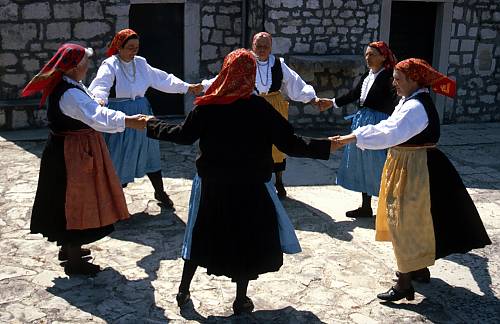
One of the cultural events I attended at Dubrovnik’s Libertas Festival was an evening of folkloric song and dance. One of the dances was silent. The only sounds that accompanied it was the shuffling of the dancers’ feet, an occasional finger snap, a collective sigh. The program explained that this was the dance of the refugees of war and of the Resistance, but either the description stopped there, or I stopped understanding.

During the war, the Croatian government became complicit with the Nazi occupation. A faction among the Serbs, who never got along with the Croats anyway, took that as an opportunity to cast their fellow Slavs – all of them – as the enemy. The selo of Gaic, where Petar and Stoja live, is extremely remote, and Serbian Resistance were scouring the countryside, terrorizing the inhabitants, and leaving much blood in their wake. For my cousins, staying put was not a option. So through the help of an underground refugee movement, they escaped. They didn’t know where they were going, how they were getting there, or when they would arrive. All they knew was that their lives and those of their children depended on leaving Gaic immediately.

So, Petar, Stoya, Petar’s sister-in-law, and their combined eleven children (one still a babe in arms) set off one night on a walk with little or no preparation. They walked for months. Their destination was always the next safe house (or farm, or factory, or cave) but they never knew two destinations in a row. Nor did they know when they would be able to stop walking. They only traveled by night, and carried no illumination.

There was, and perhaps still is, an ancient tradition among the southern Slavs, that when traveling by foot, if you meet other travelers you share food, drink, and dance. And when Petar and his family met other families along their route, they upheld the tradition. The food they had to offer was slight, and the dances were silent. The only music was the sound of shuffling feet, an occasional finger snap, a collective sigh.

The family crossed into Austria at an unpatrolled section of border. They were directed to a farm that had several large barns, and there they stayed for the duration of the war., working nights for their keep and staying hidden during the day.

“What happened when the war ended?” I asked, almost breathless from what I had just heard.

“We walked back. It was easier coming home. Protected zones were relatively safe, so we could travel by day most of the time. We even got rides in autos and wagons… Well, some of us did.” He translated for Stoja. She laughed and said something in Croatian. Petar translated for me.

“She says, ‘I was a good-looker in those days’, and it’s true she was. That meant we had to be extra careful. But now and then some young guys who missed their sweethearts, I guess, just wanted to be nice to a pretty girl, so she’d climb aboard with five or six of the kids, and the rest of us would have to walk double time to keep up.”

“What did you find when you arrived home?”

“Things were in sad shape, but we put them back together. Everyone in Gaic had taken a journey. Ravno was practically empty, too. But here we are,” he breathed in deeply. “Well. Tomorrow we take in the hay!”

Petar was up at dawn. He took his cow on a twenty minute trek to good pasture, every morning, while Stoja made bread and stew. He was eighty years old at the time.

“I’m slowing down. I walk (five kilometers) into Ravno and have to wait until the next day to walk back.”

When he returned from grazing the cow, the three of us sat for breakfast; a glass of plum brandy with bacon and cheese and bread, and a large pastry with the strongest Turkish coffee I had ever tasted. The brandy sent me for a loop, the coffee wired me. I didn’t know whether to scream or fall asleep. (They did this again at “tea time”, mid-afternoon.) Then they left for the hay field. I followed best I could.

The hay field was a plot of land that measured maybe a quarter of an acre, that they had planted in alfalfa. Once I had caught my breath, Petar explained that rain was expected the day after tomorrow, and that rain would spoil the hay.

“So, we do this right now.”

“Great! What can I do to help?”

“Sit right here on this rock.”

“Okay.”

“Watch. Tell your father and uncle what you see.”

“I’d love to work if you show me what to do.”

“Sit. Watch.”

So, I sat and I watched, feeling useless and guilty as hell. 

Petar had sharpened his scythe the previous evening, and now displayed an almost balletic mastery of the tool. The grass fell into neat rows, Stoja raked it into piles with all stems lined up, and onto a large cloth that had a loop at one end, and ties on both. Together, she and Petar rolled the fabric into a kind of burrito stuffed with hay, and tied it off. Then Stoja put the padded loop onto her forehead, and carried the roll on her back to the hay barns. They were not far away, the barns, but this was clearly the most efficient way of filling them.

While I sat and watched my cousins work, five men on horseback rode past. They were dressed like the dancers in the folkloric festival I’d seen, only they looked, and were, real. Petar and Stoja waved, the men waved back, a few words were exchanged and the group moved on.

“They’re from (the forgotten name of a nearby village). Muslims. Good, honest people, excellent neighbors. They’re hunting today, small game. They raise sheep, actually a kind of goat suited to this terrain, but they look like sheep. The best cheese!”

After another hour or two, Petar sniffed the air and announced that the rain had changed its mind and would come a day later.

“No need to hurry, now. Time for lunch.” The scythe and rake were leaned against a barn, and we strolled back to their house.

Photo: a modern, town version of the silent dance.
The Hudson

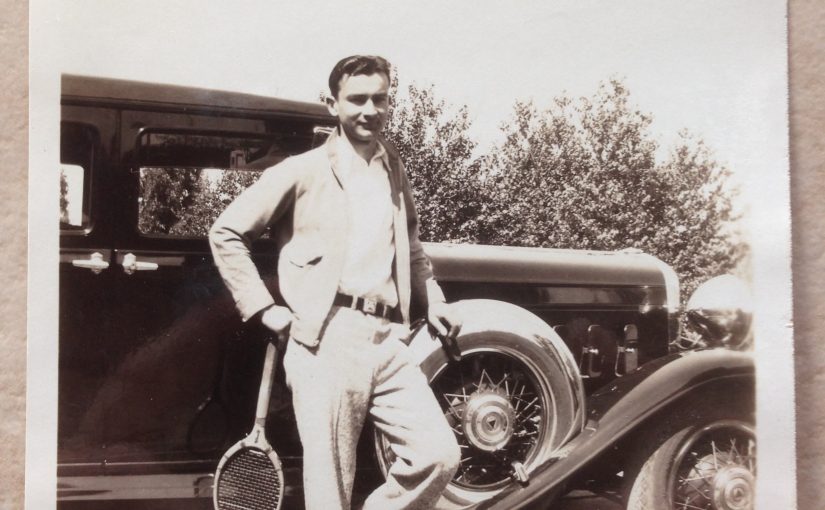
A twenty-five year old Pete Zarko leans on a tennis racket, one foot on the running board of his Hudson motorcar. It was a classy vehicle, a luxury sedan, fitted out with all the best accessories. Not a bad purchase for a young man starting out as an auto mechanic who, with his brother, tended the family orchards on weekends. The photo is dated – accurately I’m sure, by my mother whose archival talents were considerable – 1933, two years before they married and during the depths of the Great Depression.

How’d you do it, Dad? 

I do not mean to cast aspersions. My father was as honest as they come. If he discovered a 8-cent error on a customer’s bill, and the bill had already been paid, he’d spend ten cents reimbursing the overcharge. That’s the honorable thing. It’s what you do in business. Besides, the casting of aspersions has become sickeningly popular, and I tend to buck trends rather than follow them. So, nothing implied.

I’m just saying. Serious question. How did you do it?

Once he was in his thirties, the tennis racket was put into a closet (and later, a basement). The Hudson was replaced by a Ford pickup he bought for above market from a Japanese-American customer who was being sent to an internment camp. The fancy clothes I never saw. They went away somewhere well before I was born. For a brief period in the early sixties, he and his brother Tony bought a 30’s era Hudson (a beautiful thing, cream-colored with a tan canvas top) that they enjoyed for awhile then sold for a profit. But during my childhood Dad left the distinct impression that he was embarrassed by the stylish indulgences of his youth. He kept one sports coat, a herring bone tweed, that he wore for dressing up the entire time I knew him.

When I was seventeen, and beginning to wake up to the possibility of fashion, I wondered furiously what happened to the camel hair top coat and the cashmere sweaters other photos showed him wearing. I was way too skinny to have made any use of them, but cool is cool, and I would have loved to have at least tried them on. His bowler hat I discovered in the basement. It was still in its oval box. I would take out from time to time to ponder its stiffness and generous size.

How my father managed to buy such fine clothes in an era of block-long lines for soup kitchens — aside from his living in a farming community in northern California — may have been due in part to his scrupulous attitude towards money. He wasn’t afraid to spend on whatever he considered worth the cost, but he placed paying his debts ahead of taking vacations or buying a popular new appliance. I agitated for the travel, my mother for the blender. Since Mom kept the books, the blender eventually fell into budget. Road trips were more complicated, but my travel urge was sometimes satisfied by careful research as to which favored destinations boasted antique autos.

Vintage and antique cars got us to Hearst Castle, to Harrah’s collections in Reno, to various spots in the Gold Country where unusual vehicles could be found, and to state parks and beaches to frolic with collectors who gathered to show off their prizes. I loved those cars, too; the majestic, the absurd, the odd, the extravagant. The names alone were enough to warrant fascination – International Autobuggy, Hispano-Suiza, Mighty Michigan. The Simplex-Crane built in the shape of a boat by a shipping magnate in San Francisco. The Stanley Steamer that used a specially heated splash-pan to build up a head of steam on demand — the deficit of steam cars being the long wait before you could go anywhere. The embroidered electric cars with drivers’ seats that could be reversed to facilitate conversation with rear-seated passengers (presumably while parked). The perfect Tucker that broke so much automotive ground the big car companies felt compelled to litigate it out of existence, which once done allowed them to steal all the best patents.

My father owned seven antique cars in various states of decrepitude, and two antique motorcycles. His goal was to restore them all, but he couldn’t say no to his buddies. He restored several of their cars during his retirement, but only finished three of his own. Those were a Model T Ford, a Grant roadster, and a 1923 Hispano-Suiza. The Hispano was a real beauty. It turned out, however, that the original body had been substituted by one from a contemporaneous Cadillac, and that severely reduced its value. He sold it to a doctor in South Dakota who drove it all around the country, despite a gas tank that emptied into its straight six engine with alarming speed.

Some photos show my father with a pipe, another accessory I never witnessed his use of. I do, however, remember him saying in the car one night – provoked by what, I don’t recall – that if any child of his was ever caught smoking, he would beat the living daylights out of him, and for his own good, too. I was an only child, so I got that message loud and clear. Those words were as close to physical punishment as he ever came to giving. As for me and tobacco, my Croatian cousin, Pero, was a smoker, and to be polite, I would accept a cigarette from him from time to time. I pretended to puff, and after a minute or two dropped it into whatever body of water was close to hand. I’ve never understood the appeal of nicotine.

And when style is betrayed by truth, Dad’s pipe and Hudson sedan may have just been photographic props. Even the camel hair and cashmere may have been on loan. In fact, I have vague memories of that being the case, but there is no one left alive to ask. The racket and tennis whites are real, however. Because he loved playing tennis in his twenties, he convinced me to take it for physical ed in my first year of college. It was the only class I ever flunked.

I’d give anything to have a photo of Dad in his well-greased overalls, foot up on the pickup’s running board, no tennis racket. Just for symmetry. 

Recollections: Imaginings

After holiday dinners (and Sundays of any kind qualified as holidays) I would wait until Aunt Mary was comfortable on the well-worn sofa Grandma Lopin gazed down upon from her photographic portrait, chrysanthemum on her head, and beg for a story. Aunt Mary told the best stories in the world. One sentence in, and I was enthralled.

“I just say whatever comes into my head,” she laughed. “They’re not real stories.”

But they were to me. And on the occasion of my having child guests for the afternoon, if I could wrangle a story from my melodious aunt, my friends would agree; her stories were transportive.

Then one Sunday, after more effort than I thought should have been necessary, I convinced Aunt Mary to begin one of her improvisations. And I was bored. She just said whatever came into her head. What was so special about that?

Thus ended a childhood enchantment.

Was it something to do with the ranch? The orchard of broken spells?

One of my best friends as a child was a boy of about my age named David John Pace. For both of us, our friendship brought our middle names to the fore; when we were with parents, using them was the only way any of them could specify who was being yelled at.

David and I loved to play stories. One of us would begin with a setting or a character or a circumstance, and between us we’d make a movie – fabulous special effects, cast of thousands, heroic protagonists, a plot that twisted itself into knots. We could go for hours this way, and the ranch offered endless location shots – barn, chicken coup, rows of trees, and clothesline became aircraft hanger, crocodiles in a swamp, enemy lines on a battlefield, and telecommunications HQ. 

The miracle of childhood.

As with many rural houses in warm climates, my grandmother had her regular kitchen with windows and doors, and her summer kitchen on a screened-in porch. Adjacent to the summer kitchen was a concrete slab that was home to a six-lane clothesline. As clotheslines go, it was a super highway. The slab was surrounded by oleander bushes, and beyond those, rows and rows of fruit trees.

“Jack MacMillan calling Bronco, do you read me Bronco?”

“Roger Jack, read you loud and clear.”

“Get the enemy in your cross hairs, Bronco, we’re going in for a dive.”

Silence.

“We’re in an electric substation that we’re going to blow up so the enemy is without power while we booby trap the presidential palace.”

“We’re in a plane about to riddle the enemy coast guard with shrapnel.”

“Where’d you get that?”

“It’s a fight to the end!”

“Okay, hand to hand!”

And we switched narration to take us into the orchard on a dramatic chase scene, ending back at the clothesline. Dueling heroes, each intent on saving civilization, destroyed themselves on a concrete slab, both narrating the action like would-be Howard Cosells. But each narrating a different plot.

It felt weird. Like we were trying to sustain something that was over. We ratcheted up the drama, rose the stakes to dizzying heights, but we had become aware of the gears and springs that usually kept us in motion. And they weren’t meshing. The magic we never even knew was a part of our play was gone. Not ones to accept defeat (or was it progress?), we held onto the drama. But in our hearts we knew that this was the last childhood story we would weave that actually captivated us. We were growing up. 

Or were we just becoming self conscious? Or are they the same thing?

The cardinal rule of improvisation, I was later to learn in college (Dad: “We sent you to college to learn what?”) is Yes And. “Yes, I accept the reality you just depicted, And I add this to it.” When two kids start arguing about basic plot, the game is in trouble. When that happens twice in a row, there is no game. When the argument becomes the game, there are no kids left to play it.

Last I checked (and it has been many years) David John took over his father’s wholesale business. Our paths last crossed when he advised me. on my upcoming first journey to Europe, having himself recently returned. Or maybe it was when we found ourselves both in Santa Cruz, and did a little beaching while taking other kinds of trips.

I don’t know how his sense of fantasy fared when confronted with wholesale. But I have a feeling that awful dawning outside my grandmother’s summer kitchen only increased my resolve to keep the game going in some way. My subsequent personal struggle involved lots of enthusiasm for invented realities, and a strong need to involve friends in getting them to sign on to my fantasies.

Eventually, I found semi-acceptable social structures (theatre and its offshoots) in which to plant my love of improvised narrative, and although forming theatre companies could be viewed as a brand of hucksterism, in the main the theatre arts channelled my need to improvise in ways useful to the community. And for all the things in life that I missed because of my singular dedication to the stage, I got a nice hatful of ephemeral magic in return. And developed a huge admiration for those who have managed to keep the improv rolling along while raising kids and doing business. That, to me, is real growing up.

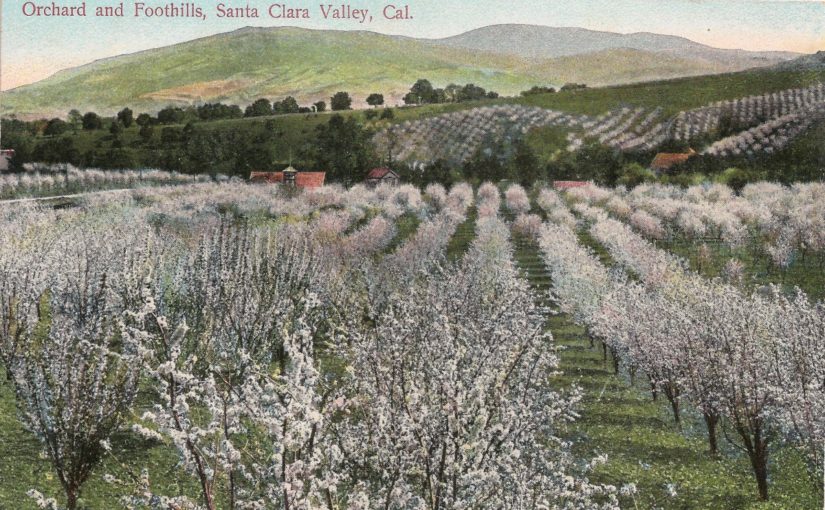
Photo: The orchards of Santa Clara Valley during a long ago spring.

Recollections: Zuljana

My visits to Cousin Pete Zarko in Gaic were coupled with visits to the Lopin side of the family in Dubrovnik and in our ancestral village of Zuljana. My Lopin grandparents were third cousins. My grandmother’s maiden name was also Lopin. They even grew up in the same selo. A Croatian village can be made of several selo, groups of houses build on rock, fertile fields separating each selo from the other. Good soil is rare in much of the country, so you don’t waste it by building. The selo my grandparents grew up in is called Pozerina, and consisted of a dozen or so two and three story houses structured around a common cistern. Water is the other precious commodity.

My first trip, in 1972, began in Dubrovnik. My cousin Zejlko was expecting me, but as was typical of my communication skills at the time, only “sometime during the summer”. I had his address, but when I arrived tired and hungry after traveling by train from Istanbul, I couldn’t gather the intelligence to find him, so with the help of the tourist office I booked a room in a private house. The host noticed my last name.

“You’re Croatian, yes?”

“My family.”

“And does your family live in Dubrovnik?”

“A few, and the others in a village not far from here.”

“There are lots of villages.”

“It’s called Zuljana.”

“Are some of your family called Lopin?”

“Yes! My mother’s cousins!”

“Zejlko is a my good friend. He has been expecting you all summer. Why are you staying here?”

Within thirty minutes, Zejlko had come to claim me and I was installed in the guest room of an apartment that was essentially a part of the city wall.

Dubrovnik was like another world to me. A perfect walled city almost surrounded by water so blue it looked fake. Libertas was (and is) Dubrovnik’s summer arts festival, and despite my temporal nonchalance (or maybe because of it) I was there for the most active part. I saw world-famous pianists, performances of folkloric dances, ballet, Macbeth on the ramparts (in Croatian), orchestras, jazz, and more. At the end of the week, Cousin Maria and her son Niko, took the ferry to Zuljana, and I tagged along.

Niko was about ten at the time. He was overweight, and he sputtered, yelled, whined, and was – like me – an only child. I tried very hard to like him. I don’t remember succeeding. Maria was a worrier, fussy, emotional, and a chatterbox. She was also a fabulous cook, so I liked her better. Her husband Miho was a man of infinite patience and calm. I thought him a saint.

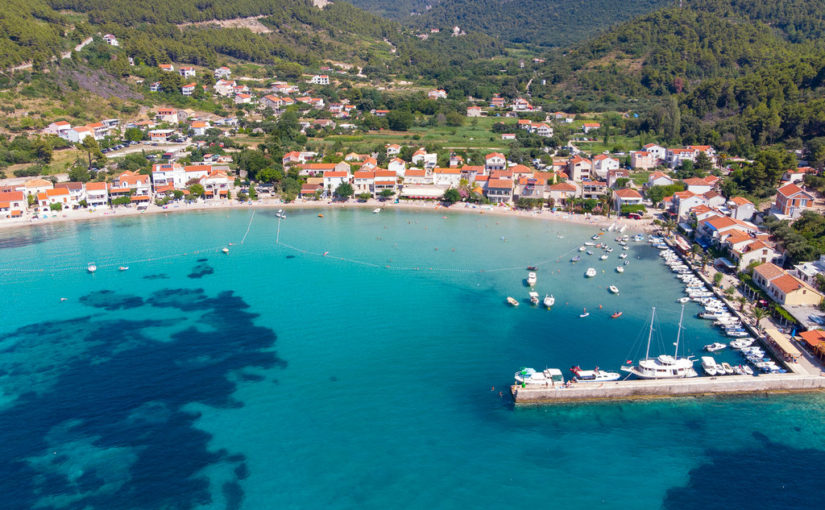
Zuljana is on the coast, and has a little artificial harbor that was provided by the Austrians. The ferry slipped through the inlet, a group of people waved excitedly, and I was welcomed back to the homeland.

Memories of my two trips to Dubrovnik and Zuljana tend to conflate, as do memories of my trips to Gaic and Ravno. It was on the first trip that I hiked up to Pozerina with cousins Pero and Navenka to look at the houses my grandparents grew up in, by then abandoned and in ruin. On the second floor of my grandfather’s house I found a box, almost the only thing in the room, and inside the box were postcards and letters. Two of those letters were from my grandfather, but only the envelopes had survived. My grandmother’s house no longer had a second floor. The cistern was overgrown with blackberries, and mosquitoes were rampant. 

Still, in my American way, I imagined a full restoration of the selo and conversion into a heritage hotel. Being me I shared the dream with everyone, and never did a thing about it. Well, my language skills that trip were pretty slight, so describing my developer’s vision was unlikely to convince, anyhow.

I had taken Russian in high school, all four years, in the hope that it would help me learn Croatian. Grandma Zarko died a year into that experiment so we never got to try it out, and though my folks both spoke Croatian fluently, it was awkward trying to speak at home. In Zuljana, I began to pick it up, but it was all about the dictionary, and conversations – if you could call them that – were painful for everyone.

Still, when a group of Czech tourists befriended my cousins, they could often not understand one another even though the two languages were close. But somehow I could understand both so I became their imperfect, and totally thrilled, translator. Then one night on the pier while we passed around a bottle of homemade sweet vermouth I cracked my first joke in a foreign language. Someone made note of the full moon, and riding on the lunar landing of a few summers prior, I declared that moonlight was now subject to an American tax. Okay, not exactly Mel Brooks, but they laughed.

Pero and his dad, Marko, were busy that summer coaxing a cistern from the granite outcrop their house was built on. They would spend an hour drilling a hole by hand, place the explosive, pack it, stretch the fuse, light it, take cover, and… boof!. Not “boom”, boof. The charge would blow a toaster-sized section of rock into a loose amalgam which Pero and Marko cleared out with pickaxes. Those two weeks saw the cistern grow to about the size of a steamer trunk. No one was perturbed by this timeline. It was the way it was.

And all that while, Veronika, Pero’s mother, carried five liter jugs of water down from a well high enough on the mountain that the water wasn’t brackish from infiltration of the sea. It was still slightly too mineral for good dental health, however, and was used mainly for cooking and washing. Water and rock shaped their lives.

When I returned three years later, the ferry had stopped running and Zejlko took me by car. We arrived late. The whole family was in Veronika’s kitchen to greet me. I had not spoken a word of Croatian in three years (Zejlko spoke English) and was groggy from travel. People asked lots of questions. I answered them. About a half hour into the conversation, someone remarked how much my Croatian had improved, and they were right.

“It was a struggle for us before, we’re glad you’ve been studying.”

More amazed than they were, I left it at that.

The big excitement was about water. Veronika went to the sink, and turned on the new faucet full blast.

“Look! We have as much as we want, now!”

“You finished the cistern!”

“No,” said Pero, “we might turn it into a wine cellar, though.”

“Where is the water coming from?”

“Canalization!” cheered Marko.

The government had given Zuljana a grant to train a villager in hydraulic engineering, then everyone in town either signed on to provide labor, or paid a kind of tax if they opted not to. Together they built a ten thousand liter reservoir high on a hill, dug a fifteen meter well down to reliably fresh water, and laid pipe to every house in the village.

“Main lines, service lines, all professional!” enthused Marko.

As close as I now live to them, and as many times as I’ve vacationed in Italy before I moved here, I’ve never been back. I regret that.

Recollections: The Fourth

My first Fourth of July was at the Lucas’s house. They lived directly across the street from Washington Park which was launch central for the Sunnyvale fireworks display. Sitting in their front yard, comfortably bunkered in lawn chairs or lounging on picnic blankets, my adult relations waited to admire the colors that would soon explode directly overhead. I was three, and had no idea what to expect. When the first sky rocket whistled into position and burst noisily above us, I wasted no time running — screaming — into the living room where I sought out furniture high enough off the floor for me to hide under. 

The bangs kept coming, muted only slightly by the walls and windows of my grandparents-on-loan’s tract house, and with every new terror I lodged myself further under the table that protected me. But the capacity for humans to adapt is remarkable, even for three-year-old humans, and as the oohs and aahs made me curious as to what I was missing, I crawled out of hiding to watch the show through the front window, and eventually on a blanket. I don’t recall if parental intervention helped get me there or not. It was an intensely personal progression – abject terror to aesthetic appreciation – and even if adults seemed to help me through it, I was basically on my own.

My later attraction to theatre caused me to face the same transition from terror to pleasure on purpose, and regularly, in both rehearsal and performance, for decades thereafter.

I don’t know if the location of our pyrotechnic parties changed because the civic display was moved from Washington Park as the city grew, which eventually was the case, or if it was a family event, like Grandpa Lucas’s passing, that changed the venue, but memories of the Fourth after those several years across from the park, are mostly set on the Lopin ranch in Cupertino.

My mother and her four younger siblings grew up on ten acres of fruit orchard their father planted around 1904 and in a house he put up in 1920. In the dining room hung formal portraits of my Lopin grandparents, my grandmother with a strange white mound on the top of her head that was identified by Aunt Mary as a chrysanthemum, but only after years of my wondering what it was. My grandfather’s portrait showed a man with a face and upper body completely out of kilter; shoulders, ears, and eyes dislevel with each other in ways almost random, and nose out of alignment in the other direction. But all in all they were a handsome couple.

Grandpa Lopin died when I was six and my cousin Gail, his only other grandchild, was about ten, and I recall very little about him. The house was of a peculiar design that required passing through bedrooms to get to other bedrooms, and in which it never quite felt that any room, except kitchen and bath, was being used for its intended purpose. My grandfather lay dying in a small bedroom immediately off the kitchen – on the way to the bath, master bedroom, and other rooms of puzzling utility – and I remember visiting him there. Gail did, too. She later told me that the day before he died, she came to see him and he kept pointing to the corner of the room.

“What are you pointing at, Grandpa?”

“He’s waiting there for me. What joy.” He wasn’t, by any report of his children, a religious man.

My mother said I could attend his funeral, but I chickened out. Later she mentioned that Gail had asked after me, if I was okay. If I was going to come pay my respects. I felt a bit ashamed for staying home.

“Gail cried.”

“She did? Why?”

“Because she missed Grandpa.”

“Oh.” I was too embarrassed to admit that I had thought she’d cried because I hadn’t come to the funeral. Always the center of the universe. Or maybe it was just a question of syntax.

The yard behind the house was shaded by a huge pepper tree and two large figs. The area beneath them was paved with green concrete, where Uncle John built a rudimentary fire pit for grilling chicken and steak, and spicy sausage of his own production. The slab also served as a good staging ground for roadside stand pyrotechnics.

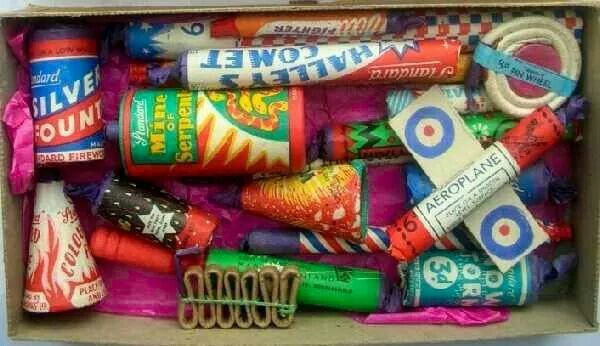
They were simple confections – a little color, bright light, and sometimes a gentle whistle – but when Aunt Mary oo’ed, and Uncle John chuckled, and Dad said “that was a good one! Let’s see what this one’s like…” the Roman candles and sparklers seemed in their simple, homey sincerity more than a fitting celebration of a nation’s bedrock principles. Don’t be fooled, though, simple and homey didn’t come cheap. The deluxe box I wanted to buy cost six dollars. It included Silver Fountains, and Vesuvius Volcanoes, Magic Serpents, Color Cones, and Cosmic Sparklers. So around Easter, my parents would start crediting my fireworks account ten cents for each time I did the dishes after supper, and if I was diligent, by July Fourth I could afford the six, maybe even the super deluxe seven dollar and fifty cent collection.

Of course, while my folks pretended those sparkly entertainments were mainly for my amusement and that was why I should earn the pleasure over the kitchen sink, I knew I was working for whoever showed up to share in shade and sausage while we waited for dark. And that was okay. Our collective enjoyment was always worth the suds and hot water. It brought us together, and the memories of those summer evenings of aromatic smoke and easy conviviality are priceless.

Recollections: Gaic

“And this is my grave. What do you think?”

“It’s nice,” I said admiringly of the sizable structure of polished stone.

“It’s big enough for the whole family. And look at the view.”

We turned together to admire the valley, rugged and dramatic. It was a fine panorama to lure and reward surviving family to come visit my cousin after he died.

I visited my living cousin twice in the 1970’s. He passed in the early eighties. Panorama notwithstanding, I never made it back to admire his grave once his body had taken up residence there.

Pete Zarko was my father’s name. It was also the name of his first cousin who lived in California’s Santa Clara Valley for twenty years beginning in 1909. Both my father and his elder brother Tony adored Cousin Pete. In family circles, he was the stuff of legend.

Tony (aka Bill) and Marian, world travelers by disposition, went to Herzegovina in 1967, I think it was, to see Pete. Bill (aka Tony) could talk of almost nothing else for a year.

Petar Zarak – as he received his mail in Ravno – returned to Yugoslavia in 1929 to find a wife. The economic crash probably kept him there. He found a good partner in Stoja, however, and when I first met them in 1972, they radiated contentment. I had connected up with their son in Dubrovnik, and together we took the train to Ravno. The name “Ravno” means “flat”. It’s a joke. The town clings to the side of a mountain.

In Ravno, we were invited to snack with other cousins, to whom I was related in ways too complicated for me to retain, then we went to a little park where a trail into the mountains began. The trail wound through the rocky landscape for about a kilometer, then it turned to a slightly beaten track, and finally it disappeared. At that point you had to have someone with you who knew the way, for no path could form on such rocky terrain.

I had written Pete from the United States saying that I was going to visit “sometime after Easter”. It was now mid-July. Technically, my estimated time of arrival was still correct, but there was no reason he should have been expecting me on that particular day. I had just contacted his son a couple of days before, and my cousins of unknown provenance had mentioned that Pete had not been to Ravno in almost a week. So it was that our group of three rounded the last bend in the invisible trail to the tiny village of Gaic, and there in its first of six houses, stood Pete in his front door and Stoja at the door to her summer kitchen.

“Well, now,” he said in perfect English, “who the devil might this be?” Stoja, to whom all English was jabber, and probably profane, wrapped me in an embrace made complex by the shawls and aprons she always wore. She smelled sweetly of wood smoke. She treated me to a hug every few minutes the whole time I was there. By sunset I understood why Uncle Bill had made the trip, and why Pete was so adored.

Gaic nights were dark in 1972. There was no electricity, few people. The sky showed more stars than I thought were visible. The sound of silence was intense. Pete lit a lamp in the winter kitchen, and Stoja prepared a dinner of fried cheese preserved in olive oil, salad, and a kind of sausage. Pete sat with me on the sofa and asked questions.

“Is that vineyard still there, the one on Stevens Creek and Stelling?”

“No, that’s a community college now. In fact, I went there my freshman year.”

“That was the Beaulieu Winery, very beautiful place. I worked there sometime. Is Le Petit Trianon still there?”

“It needs restoration, but it’s still there. Behind the library.”

“Library?”

“It’s a college?”

“Oh yes. And there was Seven Springs Ranch, Bubb’s place, they’d hire me to prune. Wow, such a beautiful valley. Perfect conditions for agriculture. Spring water everywhere, rich soil, ideal climate. What a paradise.”

“Things have changed in the last twenty years.”

“That’s what Tony said. Hard for me to imagine.”

“For me, too.”

“And the winery on… what was it? They had a fire in October, 1923.”

And so it went every evening until we could remain awake no more. When he would run out of questions, he’d tell me stories from the Old Testament until a memory appeared, then ask more questions. Most I had no answers for. His knowledge of the valley was perfectly preserved from twenty years before I was born.

“Who do you speak English with? Someone else in Gaic, in Ravno?”

“I subscribe to Time Magazine. By the time it arrives, the news is a month old, but it tells me how the language changes, and helps me to remember it. Those were wonderful times. Your father and uncle, wonderful boys. Your grandmother, my goodness, the best cook in the world…” then, in case Stoja had somehow understood, “…except for my girlfriend, here,” and Stoja pretended to be annoyed and, in Croatian, accused him of swearing.

“Swearing! Hellfire and damnation! There, that’s your swearing!” and he laughed, and she laughed, and so did I.

I stayed four or five days that time. There are so many astonishing memories from that short visit, and I will parse a few out in subsequent posts. On my second trip, I returned to Gaic in the spring of 1975 and stayed another few days. Electricity had arrived. There was a road in the village, vehicle-worthy, but a short way out of town it lost itself in the ruggedness of the terrain.

“They didn’t ask if we wanted to go anywhere,” mused Pete, “and they didn’t make it possible for us to go, even if we’d wanted to.”

My first trip to Europe in ’72 was largely by thumb, though I also took trains, planes, and boats when needed. My second in ’75 was spent mostly in Firenze, and I dropped down to visit family for a month towards the end. When I departed on that second journey, I left my Uncle Bill quite ill with cancer. He had been in the hospital for awhile, and when I saw him at home to say goodbye, I was convinced that we would not meet again in the flesh. As I was leaving, he called after me.

“You’ll see cousin Pete, won’t you?”

“I’m going to try.”

“See him. Tell him I said hello.”

“Okay.”

“Promise?”

“I promise.”

“And I want a hello back. Bring one back with you, okay?”

“Okay.”

“I’m serious.”

I left home in late February, saw Pete and Stoja in May, returned to California in June. Uncle Bill called hours later.

“When you coming over to see me?”

“Tomorrow, maybe later today?”

“Right now, okay?” I could hear my aunt in the background, “He’s just off the plane, you know what that’s like, let him come tomorrow.”

“Okay, I’ll be right over.”

He looked good that day. He was dressed, and met me in the little unused, unfinished stump of Iowa Street that abutted their property to the north. The weather was beautiful. I imagined that he’d recovered. We shook hands, he smiled. “So, tell me all about cousin Pete,” and he took me into the backyard where we could sit, and I told him what I could remember while he asked questions.

A day or two later, he died.

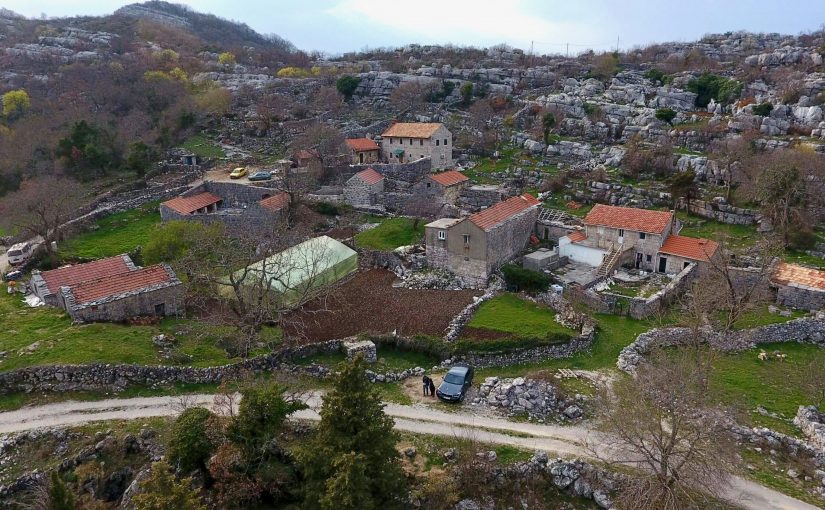
Photo: amazingly a search on Gaic yielded a photo! The two levels of red roof to the far right was Petar and Stoja’s house. The road to nowhere was obviously extended and changes the look and connectedness of the entire village, but Gaic is essentially as I remember it.

Recollections: Oil

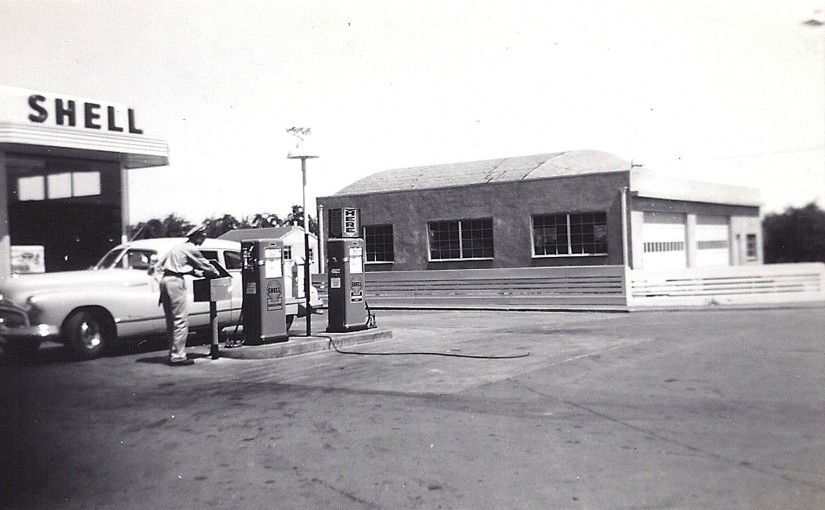
My father built his own auto repair shop shortly after the war. It was quite a grand structure with an impressively engineered single barrel vault made of timber, and with room enough for six active repair bays. In front was an office, but as my mother performed official tasks and preferred to work at home, it was never used. Instead they rented it to Fred Brackenbury who repaired radios, then a bit later, televisions. Brackenbury had a sign painted over his entrance. Dad never painted a sign, but by the time I was about six, I was pretty convinced that he was waiting to put one up that said “Zarko and Son”.

My parents bought the lot on the corner of Mathilda Avenue and El Camino Real in 1945. There was a house on it, built in 1925, and a large garden, probably a few fruit trees. They moved the house a half block away not long after they bought it to free up the property for commercial use. My mother rode inside the breakfast room during the move, because as she said, “When else will I have the chance to ride a house?” She tried to get Dad to join her, but he thought that would be silly.

My father loved mechanics like I loved theatre. In about 1920, when they were in their teens, he and his brother, Tony (aka Bill) created a functioning motor vehicle out of discarded farm equipment. His first job was as a cleaner at Redwine Ford dealership in Mountain View. Maybe he didn’t get his hands greasy pushing a broom, but at least he would be in the company of those who did.

By the end of the decade, he had gone into business with a man named Frazier, when they opened a Ford dealership on Sunnyvale’s main street. Not bad for a farmer’s son. I’m sure that Frazier had a first name, but even though he was oft-mentioned in our household, I don’t remember ever hearing it. Willard! Okay, but for home use he was always called Fraizer.

I suspect that for Fraizer & Zarko, a combination dealership and repair shop, a degree of order and cleanliness was enforced that was absent in Pete Zarko’s Garage. Once on his own, Dad could revel in grease, and he did. I loved it, too. All that caked, black goo. He’d put me to work scraping pans of some vague automotive purpose, and it was so satisfying to feel the thick resistance of a heavy layer of coagulated oil give way to the tool’s stout blade. Waste oil, and I believe even the goo, was stored in large cans and picked up weekly to be recycled. Oil was the gold of his enterprise, and he treated it with respect. He also threw the stuff that was too filled with particulate matter to be cleaned onto the ground behind the shop so he wouldn’t be bothered with weeds. I’m sure that when the City transformed the corner into a park, they had some serious environmental cleanup to do.

I was about eight when Dad first invited me to work with him on the family Ford when it needed more than windows washed. We started with simple things like cleaning spark plugs and distributors. By the time I turned ten, he had taught me how to adjust timing, clean carburetors, change oil, and top off brake fluid. By the time I was twelve I was under the car with him when the clutch needed changing, brake drums needed adjusting, and other gloriously greasy work needed doing that I remember the fun of, but not the purpose.

Still, I knew in my gut that the sign Dad wanted to paint wasn’t going to happen. I enjoyed peering into engines and rolling around under cars, and when he gave me clean up jobs, I did my best to exceed expectations (and tried to hide my disappointment at how quickly everything got messy). And I admired the garage, loved my father, and was proud of his good reputation. But I didn’t relish mechanics. Didn’t even really like riding in a car all that much, let alone fixing one. I preferred to walk.

I started taking walks as soon as it was physically possible. I vividly remember exiting Grandma Zarko’s yard on the Waverly Street side, pushing open the white gate, and heading for parts unknown. A bemused neighbor asked where I was off to.

“I’m taking a walk,” I proclaimed. And I passed three houses before my mother discovered I was gone and came running after me.

I walked to and from school in first grade. My grandmother’s house was a short distance from Adair Elementary, so it began with lunches, but quickly advanced blocks long treks.

I remember hiking home one day – it had to have been first or second grade, because Mom was still driving the 1936 Ford Victoria – about to cross Iowa Street, when she pulled up, rolled down her window, and with a radiant smile offered me a ride.

“No! Can’t you see I’m walking!?” And I truculently crossed Iowa and stomped the few blocks home.

My love of walking is in my DNA, I guess. The same way that love of a humming engine was in Dad’s.

So, here we are, I’m maybe seventeen, and we’re giving the car a tune up. I am perhaps not pretending enthusiasm as strongly as I may have done a few years prior. I had been strongly lured by a theatrical siren, and grease was losing its charm. I harbored hopes that something besides my saying it out loud would convince my father that I was not meant to follow in his footsteps.

We drain the oil pan. I take the used oil to a recycling barrel. Dad hands me the five-quart oil can to be filled from the new-oil barrel across the shop next to the restroom. I go. I fill it. The oil is transferred to the Ford engine. 

“Let’s top this sucker off just a little, I think it wants another half pint.” That’s his polite way of saying that I’d not filled the can. I sulk back to the new-oil barrel.

“Oh, my god! Oh, my god! Oh, my god!”

That’s me. My Dad never gets excited like that. However, this one time he joins me at trot.

I’ve left the tap open. There’s now several gallons of liquid gold covering the floor from parts shelves to grease rack. Totally without fuss, Dad picks up two sheets of tin, inserts a funnel with a filter into the barrel, and uttering not a word of fault or blame, we scoop as much oil as we can manage. The rest we sop up with a layer of sawdust, and sweep into a trash can.

I could see the sign saying Zarko and Son falling into an imaginary heap. It wasn’t a sin, what I’d just done, but it sure as heck was a signal, and Dad read it as clearly as I had hoped he would.

We still spent many hours leaning over fenders and scooting under transmissions, but now we did it because… well, that’s what we did together. When Dad retired early so he could restore his antique autos, he leased the business to his longtime employee, Louie, and no sign of any kind was ever painted for Zarko’s Garage. When Louie retired, the City bought the land from my father, and for a brief period before the garage was turned into a bank, I imagined what an interesting theatre it would make.

Then the City tore it down and planted trees.

Recollections: Namesakes

I never knew my paternal grandfather, Vito. 

There is a tradition in the part of Croatia my family has its roots in. The first born son is named after his father’s father, the first born daughter after her mother’s mother, then you switch sides and do it again. Child number five’s name is therefore left up to the imaginations of the parents. My mother was first of five and duly named Ann. The youngest, unbound by tradition, was called Dragutin. He hated the name, and went by Martin from his high school days on. His siblings didn’t much care for it either and called him Babe until the day he died.

So, it was expected of my parents to name me Vito. My father suggested that if I were a boy I be called Marko, and if a girl, Zorka. He was joking, which was not very helpful. So, my nomination was basically up to my mother. She took this quandary into the hospital with her, gave birth to my nameless self, and remained undecided right to the last minute. Desperate for inspiration, she turned to her roommate who had also just given birth.

“What did you call yours? I just can’t come up with anything!”

“David Allen.”

“Oh, that’s nice. How many L’s?”

“Two. It’s my maiden name.”

It was thus I became known as David Allan.

A few days later, my parents were faced with the task of presenting me to my father’s mother, a traditionalist.

“What did you name him?”

“David,” my mother gulped.

“Good. I was afraid you’d break the rule.”

Something my folks had both missed growing up; Vito is the equivalent of Dave.

Vito, the elder, died a few months after my parents married. His widow was so distraught, she begged her usually pliant son to move in with her – oh, bring the wife too — for a few months while she adjusted. Ten years, a depression, and a world war later they finally were able to move out. I believe it came down to my mother’s giving Dad a choice between her and her mother-in-law. 

Vito was, by all reports an exceptionally kind man. He was tall with flowing mustaches and wore a white ten-gallon hat. When his wife would deny one of his sons some spending money, the boy would find a gold coin in a shoe the next morning. I recently wonder if Dad moved Mom into enemy territory not because his mother need comforting, rather because he did. His younger brother already lived at home, my grandmother – who was a strong woman – had the company she needed. Many of us carry our parents with us long after their death, and I’m not sure Dad ever reconciled the grief he held for his father.

Another Croatian tradition; the man rarely marries before age 35, and his bride is usually about 20. In a rural society, this generational overlap works to everyone’s advantage. The man has a younger wife to help him in old age, the woman has grown children. My grandfather was 38 when he married, my grandmother was 18. Perhaps in asking my parents to move in with her, she was merely claiming her expected prerogative. Her twenty-seven year old childless son came with a wife who could be pressed into helping around the house. Her eldest son already had two daughters. Her youngest son was in his early twenties and modern. She chose the most practical alternative. And the path of least resistance.

She seemed to have had a good instinct as to which son would be the most compliant, which would feel Vito’s absence most keenly, and which would do his best to fill the hole that was left by his father’s passing.

Or maybe Dad offered to move back in with his mother and represented it to his new wife as a request. And maybe he heard a request when it was no more than a widow’s lament – “I will be so lonely”. History is hard to unravel. Family history all the more so for everyone believes themselves to be primary source.

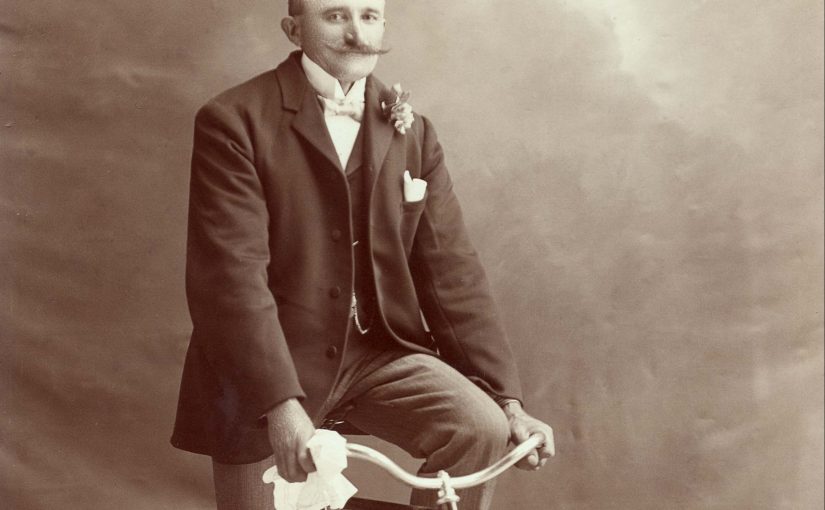
In 1910, while still working as a tenant farmer for the Willson family, Vito entered a contest and won a bicycle. His six-foot four frame and tall hat was enhanced in its romantic stature by state-of-the-art transportation. “He rode it until it wore out,” my father reported. “I was three when he won it, and still remember how proud he was.” Ten or twelve years later Dad and my uncle Tony created a motorized vehicle scrapped together from discarded farm equipment. I imagine Vito was proud of that, too, and that he provided his sons the cash to buy the few parts not rescued from a neighbor’s junk pile.

I wish I had known my namesake.

Recollections: Snow

As a lad I was quite dedicated to the Blessed Mother. Even though I’m no longer a practicing Catholic, I still experience a devotion to her, it’s just different now.

My parents rarely went to a social function without me, and when they did, it rarely lasted beyond my bedtime, so a sitter, usually from the family, would be all that was necessary. On January 20, 1962 my parents went somewhere unusual or far away, I guess, and I was invited to spend the night with Aunt Marian and Uncle Bill. When I spent overnight time with relatives, it was almost always with Aunt Mary and Uncle Jack, so this was special. 

Their house was also special – or maybe all houses are when you’re a kid. It was a sprawling “U” shape of Marian’s design that embraced a courtyard with a brick barbecue and a hanging light fixture made from an old wagon wheel. There was a large living room with a grand stone fireplace and a picture window, an ample dining room, and a huge eat-in kitchen. The master bedroom was in front (the house was generously set back from the street) while Shirley and Linda’s bedroom was in back, and included a number of really cool builtins. My cousins were living on their own by then, so I got to stay in their room. I can still remember Marian tucking me in that night. I can still remember how happy I was to be there. And I can still remember praying to Mother Mary for snow. 

What prompted that particular plea, I don’t know for certain, though I do have a dim memory of Marian (who hailed from Indiana and knew about such things) saying to my folks as they departed on the front porch that the air felt like snow. But everyone had laughed, so that I took it at all seriously… Well, maybe it was just the idea; staying over in a special place, then to wake the next morning to a winter snowscape, well that would be just fine.

And so I prayed like I’d never prayed before that it would snow. In Sunnyvale, California that had not seen snow in thirty years.

I woke early, just as light was beginning to glow. The color of the dawn seeping through the shades was distinctive, odd, exciting. My pulse picked up. I wondered if anyone else were awake. Should I go into the living room, see what lay beyond the picture window? Would that disturb anyone? If my prayer had been answered, would it matter if I woke the rest of the household? I mean, that would be a very big deal. 

I was still debating the ethics of a guest being the one to herald the day, when my aunt cracked the door open.

“Are you awake?”

“Sort of.”

“Well, you might want to get up, now. There’s a surprise.”

I bounded out of bed and into my robe and probably almost knocked Marian over in the hall as I ran to look outside. There it was. Their vast lawn was a sea of sparkling white. The trees looked like a Christmas card. The street was still pure and untrammeled.

“Call Mommy and Daddy!”

“They called me. Your mother likes to be up early. She thought you’d want to see this.”

I crossed myself a dozen times once Marian left for the kitchen (she was Congregationalist, I wasn’t sure she would understand). 

Uncle Bill was already outside, sweeping down the driveway so when my folks got there, they’d have a place to park. Marian made hot chocolate. That morning was, like, the best a kid could ask for. 

Marian and Bill took regular trips – well, to all over the world, but that’s a future story – to Lake Tahoe, so even though Bill was a Sunnyvale boy, he knew about driving in icy conditions and such. For Mom and Dad it was the first time for snow since 1932.

I’ve since lived in the northeastern United States, lived there for thirty years. I imagine myself as being over the thrill of snow, though – especially from inside a warm house – I must admit it as one of the most extravagant events nature has to offer. And it’s good to remember being a kid, and what it was like for a meteorological anomaly to be so extraordinarily exhilarating.

We drove all over town. Everything was transformed. Marian pointed out houses with melted patches on their roofs. Their occupants were up and stirring; they had turned on the heat.

“Now see, how wonderful it is to have someone with us with experience of snow,” cooed my mother. Marian was a teacher, and a good one, too. Mom could not have issued a better invitation. We were, from that point, regaled with stories of horse-drawn sleighs and of skating on frozen ponds back in Indiana. The magic for this boy was thick.

It was still early when my folks and I got home. We lived across from the city hall, a modern complex of handsome, shed-like buildings surrounded by artificial hills and valleys of lawn. Snow sat untouched on all of it, except for one set of footprints that ran up the steepest hill and down again at an angle.

“Maryanne.”

Our neighbor’s granddaughter was about my age. We were old friends, and I liked her a lot. But she was so infuriatingly impulsive. Could she not have waited a few hours at least before she marred the pristine beauty of our view?

An hour later we were both on that lawn throwing snowballs at each other.

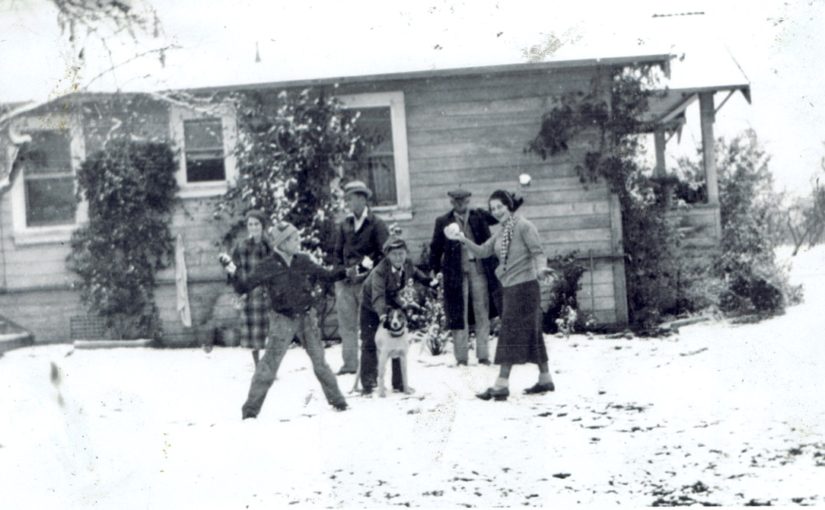
Photo: snow at the Lopin ranch, 1932

Recollections: Leftovers Friday

Even though Grandpa and Grandma Lucas were not blood relatives, it was clear to me as a child how they fit into the family. They were my cousins’ actual grandparents, on loan. How Aunt Alice and Uncle Bert figured into the family was more mysterious, and still is. They were perhaps Aunt and Uncle to my Aunt Marian, therefore Alice may have been Mattie Lucas’s sister. I’m really shooting in the dark, here. But I felt pretty much the same about them as the Lucas’s; you can never have too many uncles and aunts.

Bert and Alice lived on the same block as we did, only on the other side. We walked down South Mathilda to Olive Street, turned right, and their house was on the corner of Taaffe. (I say walked, but despite the tiny distance, we often drove.)

I loved that house. It was a California Mission bungalow, all rough troweled plaster and terra cotta roof. You entered from a small porch into the living room with a rustic fireplace. Directly opposite the entrance, a wide arch presented the dining room, which had windows along its back wall. They opened onto a patio and a walled garden filled with fuchsias. To the left of the dining room was Bert’s drafting studio; more windows, tiled floors, and a drafting table full of t-squares, triangles, Koh-i-nor pens, sharpeners, scale rulers, and velum. That room led onto a patio. To the right of the dining room was a long, narrow kitchen. There was a fancy-painted breakfast nook at the near end. Alice’s stove was several shades of green enamel, and had control knobs that were somehow in the shape of a pendant. (Don’t ask me how, it’s a memory.) Through the kitchen you could go down a set of aromatic wooden stairs to the basement where the men would gather for billiards.

It was a magical house.

I don’t remember having spent an actual holiday at Bert and Alice’s. But for some span of years, the family celebrated Leftovers Friday, when we gathered again to finish off what we were too stuffed to eat on Thanksgiving. It was better than being stuck with a refrigerator of whatever it was we had provided for the actual feast, like four Tupperware containers of mashed yams. It allowed us to continue to enjoy a varied table in each other’s company. At least a couple of these day-afters were held at Bert and Alice’s, and I remember them being more convivial than the holiday itself. Some of the adults were there on lunch hour — extended to allow for pumpkin pie — and were delighted with the break in routine. The style of service was decidedly tin-foil and wax paper, so everyone was more relaxed. If the white meat was a bit on the dry side, we all knew it already, no one had to point it out, and no one had to be embarrassed about it either.

One year when I was seven or eight, Bert had — for reasons forgotten — set up a public address system. The speakers were in the dining room, the microphone in the front bedroom. He said a few words of welcome, everyone laughed, and some of the curious went up to examine the source. I was not among the curious. It seems that I’d heard the voice, paid little attention to the words, and assumed someone had turned on the radio. I wanted Dad to take me downstairs for a game of eight ball.

It was often on a Tuesday when there was nothing worth watching on TV.

Uncle Bill would show up unannounced, and tease my father into doing his day-end bookwork a bit later than usual so we could go over to Bert’s for pool. I don’t know how Dad spared the time. His billings could take more than an hour, he seldom got home before 7:00, and was in bed by 10:30. But two or three times a month he agreed to join his brother for billiards.

There was a rotating group of regulars, and my uncle could always scare up one of them to round the group out to a regulation four; he and my dad, Bert, and another guy from the neighborhood. They played the real thing, billiards with two white balls and a red, cushion shots, elegant set ups, arcane terminology. There were pictures on the walls of dogs playing poker, of sylphs standing prettily in a bosky glade, of an old woman and her butcher weighing a chicken, both disrupting the scale in their favor. The men swore. My father almost always won. His background as a machinist fit nicely into the precision of the game.

After a few rounds with his friends, or if a second neighbor showed up to crowd him out, he’d come over to the pocket billiards table, colloquially known as pool, and combination play and teach me through several games. These were good tables – slate beds, oak gutters, thickly felted cushions. The balls made a wonderfully satisfying rumble as they returned from their pockets to the rack at table’s end.

That’s where I wanted to go while we waited for leftovers to be heated and served. But Dad enticed me to take a look at the microphone in the front bedroom. Bert followed. It was a splendid thing, this microphone; chrome and shining, hefty and complex. Bert turned on the amp and tested the mic with a tap.

“Say something.”

I was too shy.

“Try it. Have you never used a microphone before?”

“No,” I mumbled into my sweater.

“Well, I’ll leave it on in case you get the urge.”

I followed them back to the dining room. Not a word was uttered about pool or the basement. A few minutes later I gave in to the call of fate and retraced my steps to the microphone.

“Hello.” My voice boomed back at me from twenty feet away in a most satisfactory manner. “Hello to everyone in the dining room.” That got a laugh. This felt dangerous. “And welcome to Leftover Thanksgiving hosted today by our favorite aunt and uncle, Alice and Bert! Let’s hear a round of applause!” They clapped. My future as a striving theatre professional was sealed in that moment. 

I have been justly accused of extending pre-show curtain speeches past the useful limit while functioning as artistic director at one theatre or the other. It was an indulgence with roots in that microphone.

I couldn’t stop talking. I listed names of family and their imagined responsibilities for the day. I reviewed the dishes on order, complimented the cooks, anticipated who would have to leave early and who would get stuck with washing up. Who would get to take home the leftover, leftover stuffing.

After several minutes of my imagining a happily amused audience, rapt at my wit and sophistication, my father crept in.

“Just going to adjust the volume, here,” he said, masking the amp with his body.

“Not loud enough?”

“Something like that.”

He returned to the table, I kept right on going. Uncle Bill had to interrupt to let me know that I was missing the turkey. I imagined glowing faces and an enthusiastic welcome, the way you saw an audience greet its adored master of ceremonies on television.

There was none of that. Everyone was eating, laughing, talking. My cousin Shirley patted the chair next to her. My plate was already filled.

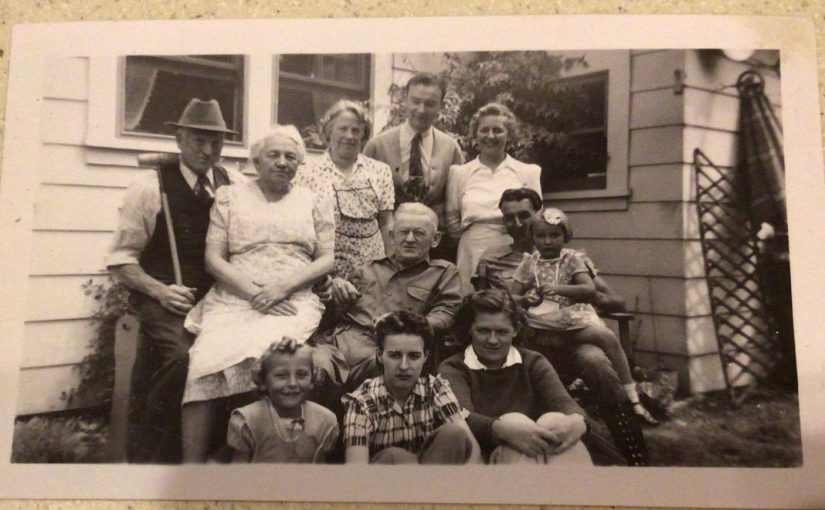
Photo: Bert is seated center, Alice is standing behind him.